

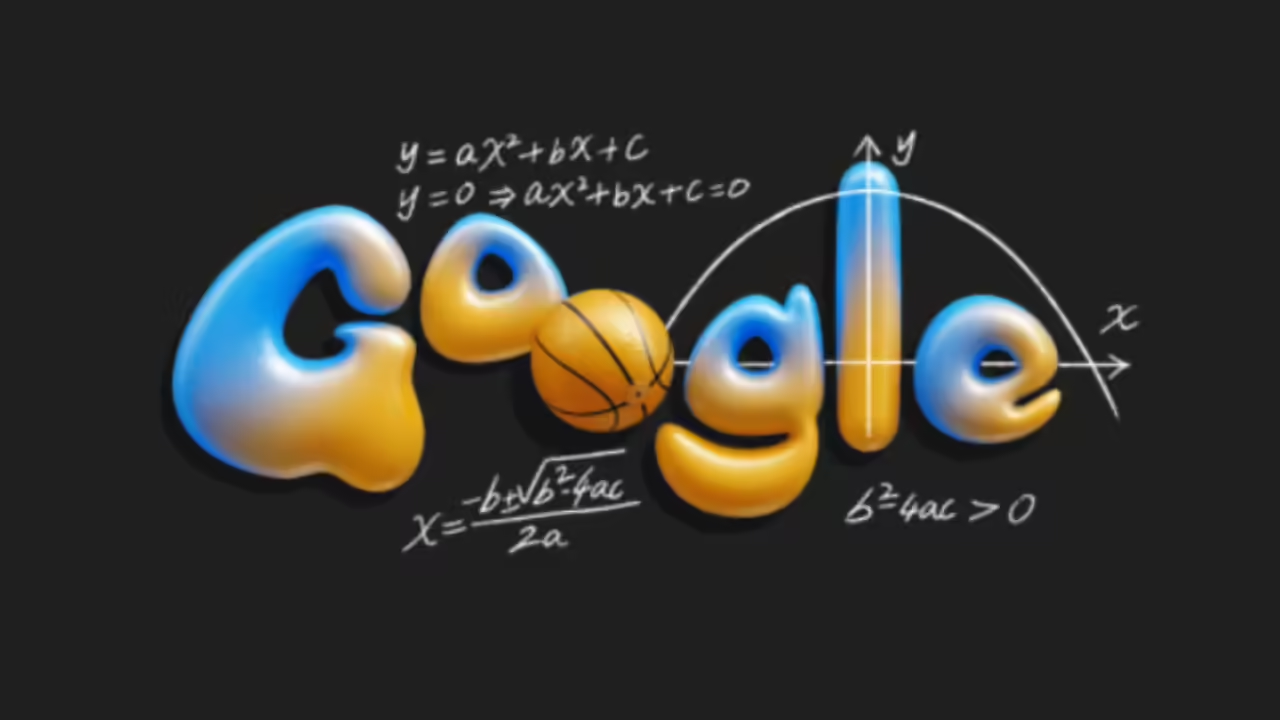
A rare fusion of mathematical heritage and artificial intelligence transforms the world’s most-visited webpage into an interactive classroom
In an age where mathematical literacy increasingly determines technological fluency, Google has deployed its most visible canvas—the homepage Doodle—to resurrect enthusiasm for what might be algebra’s most consequential formula. Launched globally on November 12, 2025, “Learning the Quadratic Equation” represents something more sophisticated than corporate whimsy: it’s an experiment in using AI-augmented visual storytelling todemystify the mathematical structures that quietly govern everything from bridge spans to basketball trajectories.
The quadratic equation—that deceptively simple arrangement of variables expressed as ax² + bx + c = 0—has occupied an unusual position in educational consciousness. Nearly universal in secondary curricula, yet frequently dismissed as abstract theory, it functions as a kind of mathematical shibboleth: those who grasp its utility cross into scientific literacy, while others remain convinced they’re solving problems that don’t exist.
What distinguishes this Doodle from its predecessors is its refusal to merely commemorate. Click the animation, and you’re not directed to a static Wikipedia entry but rather into conversation with Gemini AI, Google’s large language model now moonlighting as a mathematics tutor. The system doesn’t simply solve equations—it contextualizes them.
Consider the basketball shot, one of the Doodle’s featured applications. The arc of the ball becomes a parabola, that elegant curve generated when quadratic functions are graphed. Suddenly, the abstraction acquires physical form: the equation predicts where the ball will land, how high it will rise, at what angle it should launch. Physics and algebra converge in a way that textbooks have struggled to convey for generations.
This interactive architecture suggests a broader pedagogical shift. Mathematics education has long grappled with the relevance problem—students asking “when will I ever use this?” while teachers fumble for convincing answers. Google’s approach sidesteps that impasse by embedding the formula within scenarios already familiar to its users, then deploying AI to field the inevitable follow-up questions that static content cannot accommodate.
The Equation’s Distributed Genealogy
The quadratic formula’s history reflects mathematics itself: a collaborative, cross-cultural accumulation of insight rather than any single eureka moment. Babylonian clay tablets from 2000 BCE contain geometric methods for solving quadratic problems. Egyptian papyri reveal similar approaches. By the 7th century, the Indian mathematician Brahmagupta had formalized systematic solutions for second-degree equations, establishing methodologies that would eventually reach Islamic scholars and, through them, Renaissance Europe.
This distributed genesis matters. The formula’s universality isn’t Western appropriation but rather evidence of mathematical truth’s cultural transcendence—a pattern recognition so fundamental that civilizations separated by millennia and geography independently converged upon it.
Where Quadratics Quietly Calculate
The equation’s applications extend well beyond academic exercises:
In structural engineering, quadratic relationships determine load distributions across bridge cables, the stress tolerances of building materials, the optimal curvature of arches. Every suspension bridge is essentially a physical manifestation of quadratic principles.
Economic modeling relies heavily on quadratic functions to represent cost curves, profit maximization points, and market equilibrium conditions. The U-shaped curves in microeconomics textbooks? Those are parabolas, generated by quadratic equations mapping relationships between price, quantity, and revenue.
Computer graphics and game physics employ quadratic calculations millions of times per second—rendering realistic trajectories for thrown objects, calculating collision points, generating smooth curves in vector graphics. The digital worlds we inhabit are quadratically constructed.
Machine learning algorithms frequently optimize using quadratic loss functions, measuring the distance between predictions and actual values. The AI that now teaches quadratic equations was itself trained using them.
The AI Tutor’s Quiet Revolution
Google’s integration of Gemini AI into this Doodle represents something more consequential than novelty. Traditional search returns static results—articles, videos, worked examples. The AI-augmented experience provides something closer to Socratic dialogue: users can probe assumptions, request alternative explanations, explore edge cases. The system adapts to confusion signals, rephrasing explanations or offering analogies tailored to the questioner’s apparent knowledge level.
This conversational interface addresses what educators have long recognized as mathematics’ steepest barrier: not the concepts themselves, but the moment of incomprehension where the textbook offers only the same explanation again, slightly louder. An AI tutor, by contrast, maintains infinite patience and can generate dozens of alternative framings until one resonates.
The broader implications for mathematical literacy are worth considering. If AI-assisted tools can provide personalized, context-aware guidance at scale—accessible from any device, in any language, at no cost—then the traditional constraints on mathematics education begin to dissolve. The limiting factor becomes not access to instruction but motivation to engage.
Timing and Reach
The Doodle’s initial September 8 launch in the United States and United Kingdom has now expanded to India and other regions, deliberately coinciding with National Mathematics Day campaigns and STEM advocacy initiatives. This phased rollout reflects Google’s recognition that mathematical enthusiasm requires cultural scaffolding—alignment with existing educational priorities rather than imported imposition.
In India particularly, where mathematical excellence has deep historical roots and contemporary significance for the technology sector, the Doodle arrives within a context already primed to receive it. The quadratic equation isn’t foreign abstraction here; it’s part of a continuum stretching from Brahmagupta to Ramanujan to the country’s current generation of engineers and computer scientists.
The Formula’s Democratic Persistence
What makes the quadratic equation worthy of this attention is ultimately its accessibility. Unlike higher mathematics that requires years of specialized study, the quadratic formula can be taught to fifteen-year-olds and applied immediately. It’s powerful without being esoteric, useful without requiring advanced credentials. In an era of increasing technical specialization, it remains one of the few mathematical tools genuinely available to generalists.
That Google—a company whose search algorithm began as a mathematical formula—would choose to honor another formula speaks to institutional self-awareness. The systems that organize the world’s information rely on mathematics that, while more sophisticated than quadratics, descend from the same impulse: the conviction that patterns can be captured, relationships quantified, and useful predictions extracted from symbolic manipulation.
The Doodle will disappear tomorrow, replaced by some new illustration. But it leaves behind a question worth contemplating: if a formula from Babylonia can still solve problems in 2025, rendered accessible through AI that didn’t exist months ago, what does that suggest about the permanence of certain kinds of knowledge? Perhaps some truths, once discovered, simply await new means of transmission—each generation finding fresh vocabularies for insights that remain fundamentally unchanged.
The quadratic equation endures not because it’s been mandated by curricula, but because reality itself keeps generating second-degree relationships that demand second-degree solutions. Google’s Doodle doesn’t celebrate the formula so much as acknowledge what was always true: we’ve been living in a quadratic world all along. Now we can finally see the parabolas.
– Krish M Pakanati


