

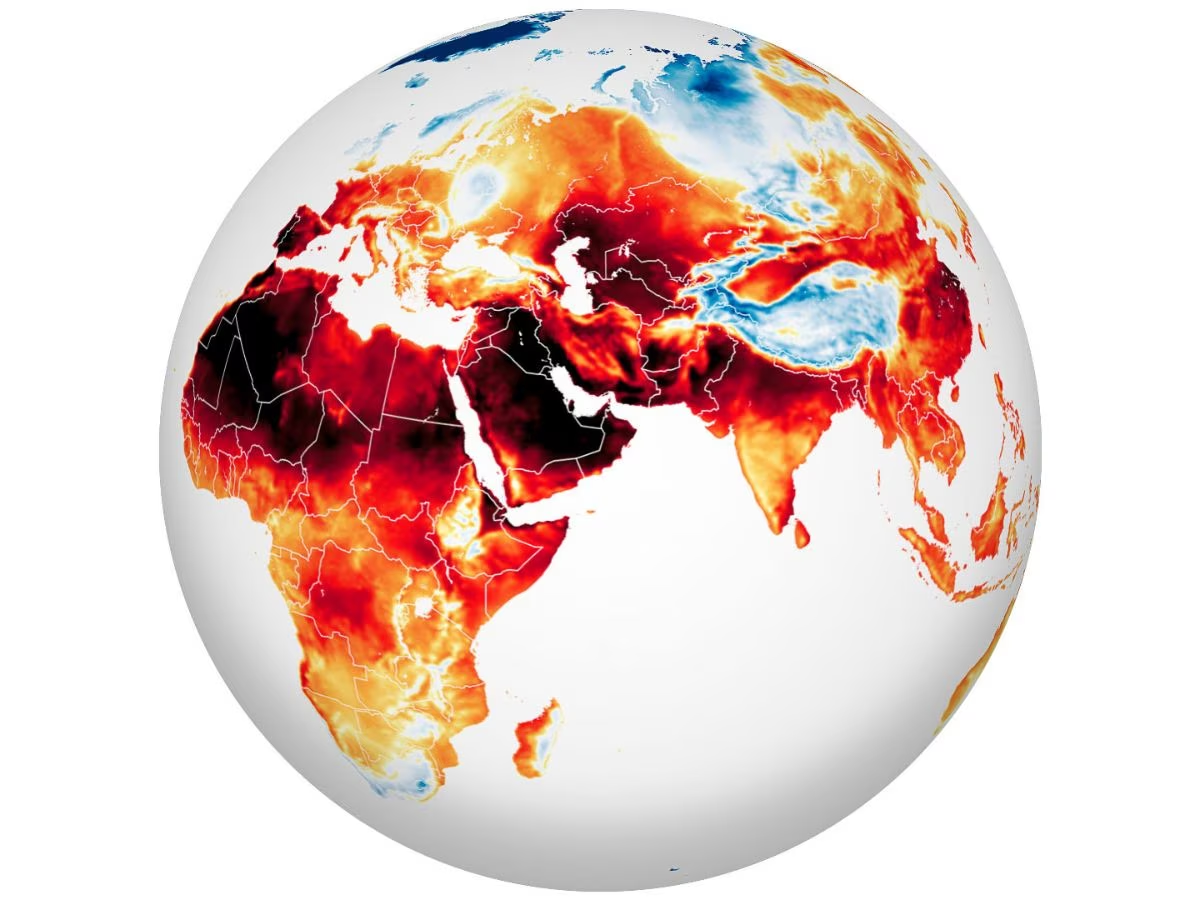
An Automatic Weather Station(AWS) of the India Meteorological Department at Mungeshpur, New Delhi, recorded the highest temperature of 52.9 degrees Celsius on 29 May 2024. This was highest-ever temperature recorded in India, breaking all previous records. Such record breaking temperatures and severe heatwaves condtions in north India are not isolated events as several other countries across continents in the southern hemisphere experienced similar above normal temperatures this year.
From Columbia and Brazil in Latin America to South Africa, Gabon, Kenya, South Sudan, Algeria, Tunisia, Guyana to Indonesia, temperatures soared to more than 3 to 4 degrees Celsius above normal. Such severe heatwaves conditions could be related to dramatic spikes in temperatures in the stratosphere that extends up to 50 km in the upper atmosphere. This is causing unprecedented instability that is leading to the splitting of Antarctic polar vortex for the first time in over two decades. Scientists believe that this is triggering significant warming in Antarctica and unusually hot, dry summers across continents in southern hemisphere from Australia to Africa to South America, according to a recent report in the New Scientist journal.
First, let us understand how it works? The global weather patterns are connected to the movement of hot and cold air in the atmosphere. While air is a mixture of gases making up the Earth’s atmosphere, wind is referred to as the movement of this air due to differences in atmospheric pressure. The primary driver of the generation of winds is the uneven heating of Earth from solar radiations due to its tilt and rotation that causes evaporation of moisture leading to upward movement of humid air as it is lighter than dry and cold air. The rising hot air creates a partial vacuum at the ground level and the surrounding cooler air is sucked in creating areas of low and high pressures in the atmosphere. As the rising hot air cannot keep on rising, it eventually begins to move sideways as it cools. At some point it begins to sink reaching the ground where it gets pulled again into the partial vacuums under updrafts. This happens at all scales, from isolated thunderstorms to global convection cells. And, because the Earth is rotating, the air motion gets deflected due to the Coriolis Effect that is deflectionof air to the right in the northern hemisphere and to the left in the southern hemisphere.
Coming back to Antarctic polar vortex, it’s just a large mass of cold air at the polar regions, both over Antarctic as well as Arctic regions. This happens due to global wind circulation patterns and also because the polar regions receive less light per unit area from the sun. These vortices in the atmosphere are driven by the temperature difference between the warmer equatorial regions and the colder poles. But there is difference between the Antarctic and Arctic polar vertices due to their geographic locations. Antarctica is surrounded by ocean that forms a buffer zone between the nearest continents where temperatures gradients are similar as that around the pole making the southern polar vortex more uniform and stable. Contrary to this, Arctic region is surrounded by ocean and land around the pole that have different temperatures. This causes the winds of the Arctic polar vortex, created by the general cold pole and warm equator, to vary on finer scales as it traverses these hot and cold regions. As a result, the northern hemisphere polar vortex has more “wobbles” in it in comparision to southern hemisphere polar vortex that is more stable.
Scientist studying the behaviour of the Antarctic polar vortex observed that the southern vortex has weakened dramatically with wind speeds plummeting, allowing cold air to escape and warm air to invade Antarctica. They have warned that repeated wind slowdowns could lead to a sudden and dramatic change in the vortex’s pattern that is showing a stretching on either side and may probably split exacerbating the already extreme condtions in the southern hemisphere. Such kind of shifts and splits are often observed in the Arctic polar vortex that is caused by sudden stratospheric warming pushing the cold polar air further south creating extreme weather events in Europe and further south.
The warming of stratosphere may be attributed to the climate change due to anthropogenic activities but, the events like the Hunga Tonga-HungaHa’apai volcanic eruption in southern Pacific on January 15, 2022 is adding up to the dramatic spikes in temperatures in the atmosphere, making the southern polar vortex unstable. This volcanic eruption produced the largest underwater explosion ever recorded by modern scientific instruments, blasting an enormous amount of water and volcanic gases higher than any other eruption in the satellite era. It is the largest recorded since the eruption of Krakatoa in 1883 in the Sunda strait in Indonesian archipelago. The eruption triggered tsunami waves of up to 15m that struck the west coast of Tongatapu, ‘Eua and Ha’apai in Tonga, South Pacific Ocean.
The implications of shift and probable split in southern polar vortex may lead to increased temperatures in Antarctica leading to shrinkage of ice cover leading to sea level rise in near future. The continents in the southern hemisphere may witnessed severe heatwaves and drought conditions following this phenomenon. The heatwaves in 2024 across continents is a pointer to what is going to come. It is high time that climate change is taken seriously by keeping aside the politics of it, before it becomes irreversible. It is better to act and repent than not to act and regret.


