

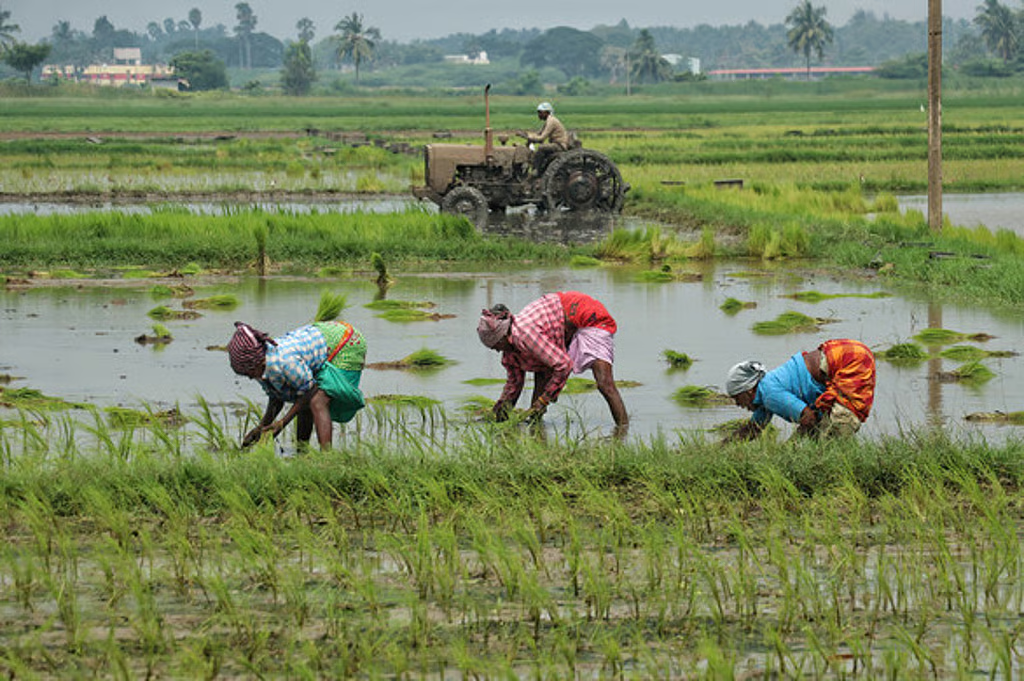
State-Wide Campaign Mobilizes 10,000+ Officials for Direct Farmer Engagement While Advancing Indigenous Organic Production Systems and AgriTech Integration
From November 24 to 29, 2025, the Government of Andhra Pradesh launches an unprecedented state-wide agricultural engagement campaign titled “Raitanna… For You”—a comprehensive initiative designed to fundamentally restructure India’s agricultural systems through direct institutional connectivity between government administration and farming communities. The campaign represents far more than conventional agricultural extension programming; it constitutes systematic deployment of government administrative capacity to facilitate household-level farmer engagement encompassing approximately 46.5 lakh individual beneficiaries across state-level agricultural welfare schemes, coupled with technical knowledge dissemination on five strategically integrated agricultural development pillars.
Chief Minister N. Chandrababu Naidu directed this mobilization through a teleconference with over 10,000 officials representing the Departments of Agriculture, Allied Sectors, and personnel from 2,200 RythuSevaKendras (RSKs—Agricultural Service Centers) across the state. The directive explicitly transcends traditional agricultural advisory modalities, mandating that public representatives (Members of Legislative Assembly) and officials conduct household visits across all villages to ensure comprehensive awareness regarding five strategic agricultural principles.
This household-visitation mandate reflects deliberate administrative choice—rather than relying on passive information dissemination through agricultural extension materials, mass media, or voluntary farmer participation in extension workshops, the state government positions itself as an active institutional agent directly engaging farmer households. This approach acknowledges documented barriers to agricultural technology adoption: information asymmetries, skepticism regarding external advice, literacy constraints limiting accessibility to written materials, and physical barriers preventing farmer attendance at centralized extension workshops in district headquarters. By deploying government officials and elected representatives into farmers’ residential spaces, the campaign eliminates these access barriers while simultaneously signaling political commitment to farmer welfare—a signaling mechanism potentially amplifying receptivity to technical guidance.
Five Strategic Agricultural Principles
The campaign anchors around five interconnected strategic principles, each addressing distinct constraints in India’s current agricultural system:
Principle 1: Water Security through Micro-Irrigation and Tank Rehabilitation: Water availability constitutes the primary constraint limiting agricultural productivity across Andhra Pradesh. The state experiences highly erratic monsoon patterns, with precipitation coefficient of variation exceeding 40% across regions, creating severe inter-annual yield volatility. Micro-irrigation systems—including drip irrigation (discharging 2-4 liters per hour through laterals positioned at crop root zones) and sprinkler systems (delivering 30-50 millimeters of precipitation per hour distributed across 15-20 meters)—reduce water application requirements by 30-50% compared to flood irrigation while simultaneously improving water distribution uniformity and crop yield consistency.
Tank rehabilitation addresses historical water infrastructure degradation. Andhra Pradesh historically maintained approximately 68,000 irrigation tanks serving as decentralized water management infrastructure, with cumulative storage capacity exceeding 2 million acre-feet. Desilting, embankment reconstruction, and ecosystem restoration—collectively termed tank rehabilitation—enhance water storage capacity by 20-40% while restoring hydrogeological connectivity between tanks and groundwater systems, creating feedback mechanisms through which surface water infiltration gradually replenishes groundwater aquifers. This recovery of historical tank systems creates synergistic benefits: reduced groundwater extraction pressure (reducing drilling depth requirements and associated energy costs), improved dry-season water availability, and ecosystem restoration supporting fishery production and biodiversity conservation.
Principle 2: Demand-Based Crop Diversification and Market Intelligence Integration: Historically, Andhra Pradesh farmers have engaged in production planning through culturally-transmitted agricultural traditions rather than market signal integration. This approach generates systematic misalignment between production and demand. For example, paddy cultivation concentrates in the delta region despite market saturation creating annual price crashes of 25-40% following harvest season peak-supply periods. Simultaneously, high-value crops (vegetables, fruits, spices) experience chronic supply deficits generating year-round price premiums exceeding 100% above production costs, yet face limited adoption due to perceived production risks and insufficient extension support.
Demand-based crop diversification integrates market intelligence systems with production planning. The Acharya NG Ranga Agricultural University (ANGRAU) operates the Agricultural Market Intelligence Cell (AMIC), which generates pre-sowing, mid-season, and pre-harvest price forecasts for principal crops (chillies, cotton, sorghum, groundnut, turmeric, maize, pulses), disseminating forecasted prices through SMS (Short Message Service) to registered farmers. This enables farmers to modify crop selection before sowing decisions, aligning production with anticipated market demand and maximizing price realization potential. Recent agricultural modifications permit cultivation of diverse high-value crops alongside traditional staple cereals, enabling portfolio diversification that reduces income volatility while maintaining food security through intercropping systems.
Principle 3: AgriTech Integration—Drone-Based Spraying and Precision Soil Assessment: Agricultural mechanization, historically concentrated in land preparation (tractor-driven plowing), has expanded toward crop protection and maintenance operations. Agricultural drones—quadcopter systems equipped with pesticide/fertilizer tanks and autonomous flight programming—exemplify this mechanization expansion. Operating parameters include spray application rates of approximately 2-3 liters per minute across 15-meter swath widths, enabling pesticide application over one acre within approximately 7 minutes compared to 120+ minutes for manual spraying with backpack sprayers or manual ground application equipment.
The efficiency advantage translates into multiple benefits: labor cost reduction (spray operations typically represent 15-25% of annual agricultural expenditure), chemical savings (precision application reduces chemical application volume by 20-30% while improving distribution uniformity), and timeliness optimization (weather windows for pest control narrow to 2-3 day intervals during critical growth stages—mechanized application preserves these windows while manual application cannot achieve such temporal precision). The Andhra Pradesh government has implemented drone subsidy programs providing 80% government support for drone acquisition by farmer groups, with anticipated establishment of 875 Drone Custom Hiring Centers (CHCs) across the state by 2027.
Soil health cards—comprehensive micronutrient assessment documents generated through soil sample analysis—address systematic nutrient deficiency patterns limiting yields despite conventional fertilizer application. Andhra Pradesh’s soils exhibit widespread deficiencies in secondary nutrients (sulfur, magnesium) and micronutrients (zinc, boron, iron), where conventional NPK (nitrogen-phosphorus-potassium) fertilizers provide no supplementation. Targeted nutrient application guided by soil health cards improves crop yield by 15-25% for the same fertilizer expenditure. Digitization initiatives enable soil sampling through RSKs, automated analysis through laboratory networks, and digital soil health card delivery, facilitating spatially-targeted nutrient management.
Principle 4: Food Processing and Value Addition at the Farm Gate: Post-harvest losses in Indian agriculture range from 15-30% depending on crop category, representing annual losses exceeding ₹75,000 crores nationally. These losses concentrate in perishable commodities (vegetables, fruits, fish) where storage periods exceed 3-5 days. Food processing—transforming agricultural commodities into processed products with extended shelf life—enables temporal arbitrage, converting seasonal production gluts into year-round availability, accessing premium-price periods following harvest season, and enabling value capture at processing stages rather than limiting farmers to raw commodity sales.
The Andhra Pradesh Food Processing Policy (operationalized in 2024-25) provides capital investment subsidies of up to 35% for agro-processing units established in MSME parks and Mega Food Parks distributed across all 175 Assembly constituencies. This decentralized infrastructure approach targets tier-2 and tier-3 cities, decentralizing food processing capacity away from traditional metropolitan concentration. Cold chain infrastructure—refrigerated transport vehicles, pre-cooling units, ripening chambers—particularly benefits perishable crop categories, extending shelf life from 3-5 days (unrefrigerated) to 15-30 days (under controlled atmosphere storage). For farmers near processing units, this infrastructure enables distress-free sales during surplus season followed by reprocessed product purchases during scarcity seasons, creating de facto income smoothing mechanisms.
Principle 5: Government Support and Last-Mile Welfare Scheme Delivery: While four principles focus on technological and market interventions, the fifth acknowledges persistent farmer support requirements. Chief Minister Naidu emphasized delivery of state and central government welfare schemes targeting farmer income supplementation. The AnnadataSukhibhava scheme provides direct income supplementation of ₹6,000-₹12,000 annually to registered farmers (beneficiary threshold: farmland exceeding 0.2 acres), administered through state government budget allocations. The PM-KISAN scheme (Central government program) provides ₹6,000 annual income transfer in three installments. Combined schemes have generated ₹6,310 crores in transfers across 46.5 lakh farmer beneficiaries over 17 months (through November 2025).
Last-mile delivery challenges—administrative delays preventing benefit realization, eligibility verification barriers, payment delays exceeding 30-60 days—remain significant constraints. Digital governance platforms (Mana Mitra WhatsApp governance, e-Panta digital agricultural systems) enable direct digital benefit transfers, reducing intermediation points and administrative delays. Direct Benefit Transfer (DBT) mechanisms enable payment within 48 hours following beneficiary eligibility verification, addressing historical payment delays that frequently necessitated emergency financial borrowing during benefit disbursement gaps.
Institutional Framework
Beyond the five principles, the campaign architecture incorporates implementation support mechanisms:
December 3 Workshops: Follow-up workshops conducted at RythuSevaKendras involving coordinated participation from Agriculture, Allied Sectors, and Marketing Department officials provide technical depth beyond household-visitation summary messaging. These workshops enable demonstration of practical techniques (micro-irrigation installation, soil sampling methodologies, drone operation, food processing processes), hands-on training in farmer producer organization (FPO) formation, and collective benefit aggregation mechanisms.
Multi-Stakeholder Engagement: The campaign extends beyond farmers to encompass entire rural household systems. Chief Minister Naidu directed awareness extension to dairy farmers, poultry producers, sheep-rearing practitioners, aquaculturists, horticulturists, and sericulture farmers—recognizing that agricultural income diversification increasingly depends on integrated crop-livestock farming systems generating complementary production and income streams.
APCNF: The Natural Farming Paradigm and Public Health Integration
Complementing the five-principle campaign, Andhra Pradesh continues advancing its Community-Managed Natural Farming (APCNF) program, a distinctive state-level initiative that embeds natural farming within institutional governance structures. Unlike conventional agricultural extension promoting isolated practices, APCNF constitutes a comprehensive philosophical and operational transition from chemical-intensive agriculture toward agroecological production systems emphasizing soil biology, ecosystem services, and integrated pest management through ecological mechanisms rather than synthetic pesticides and fertilizers.
APCNF Scope and Institutional Integration: The program encompasses approximately 6 million farmer households across 8 million hectares of cultivated land (as of November 2025), positioning it as the world’s largest transition to agroecology. Implementation operates through nested institutional structures: RythuSadhikaraSamstha (RySS—state government agricultural entity), Women-led Self-Help Groups (SHGs) functioning as community resource organizations, Community Resource Persons (CRPs) providing farmer-to-farmer extension, and Junior CRPs (iCRPs) recruited from successful farmers to encourage peer-learning and adaptation.
Certified and Traceable Production: Export Market Positioning: Chief Minister Naidu emphasized that APCNF distinctly emphasizes “certified and traceable” natural produce—a critical market differentiation mechanism. Market research indicates that consumers in European, North American, and affluent Asian markets apply willingness-to-pay premiums of 20-40% for certified organic products, with higher premiums (50-100%) for traceable products incorporating supply-chain transparency documentation (farmer identity, production methods, input records, pesticide residue test results). This premium pricing creates economic incentives for organic transition, enabling farmers to realize higher incomes through natural farming compared to equivalent conventional production, rather than accepting income reductions during transition periods.
Certification mechanisms through Participatory Guarantee Systems (PGS) and third-party certifications (JAIVIK BHARAT, various international organic certification standards) enable market access to premium-price segments. APCNF-linked Farmer Producer Organizations (FPOs) aggregate and market natural produce through Rythu Bazars (farmer-operated wholesale markets), direct-to-consumer channels, and export pathways. FPOs with turnover exceeding ₹5-10 crores annually benefit 1,000-10,000 farmers, providing marketing infrastructure that individual farmers cannot access independently.
Public Health Integration as Governance Rationale: Chief Minister Naidu explicitly framed natural farming as “a public health intervention” addressing chemical accumulation in food chains. This framing reflects epidemiological evidence linking pesticide exposure to documented health effects: farmer populations exposed to agricultural chemicals experience elevated incidence of neurological disorders (peripheral neuropathy, Parkinson-like syndromes) and certain malignancy categories. Pesticide residues in food products—despite regulatory testing—create chronic low-level dietary exposure, particularly problematic for children whose developing nervous systems demonstrate heightened vulnerability to neurotoxic exposure.
APCNF impact research (2023-24 Kharif season assessment) documented that villages with chemically-intensive agricultural systems incurred 26% higher health expenditure than APCNF villages, reflecting reduced pesticide-related health costs, lower incidence of acute poisoning events, and improved dietary diversity enhancing nutritional status and chronic disease prevention. These health metrics, while secondary to production-focused agricultural analysis, reflect broader recognition that agricultural systems produce externalities extending beyond production economics into population health domains.
Economic Performance: Income and Cost Dynamics
Research on APCNF economic performance (2019-20 baseline, 2022-23 follow-up) demonstrates:
- Input Cost Reduction: Paid-out agricultural costs under natural farming average 50-70% of conventional farming costs, primarily reflecting elimination of synthetic fertilizer and pesticide expenditure. For rice cultivation, natural farming reduces costs by 45-50% compared to conventional systems delivering equivalent yields.
- Yield Maintenance and Income Enhancement: Contrary to conventional perception that organic farming reduces yields, APCNF yields remain equivalent to or exceed conventional yields for most crops when appropriate agronomic practices are implemented. Net returns (gross returns minus paid-out costs) average 49% higher under APCNF than conventional farming due to cost reduction magnitude exceeding any yield differential.
- Price Premiums: Certified natural produce commands 15-25% price premiums in domestic retail markets, with export segments achieving 30-40% premiums. In international markets, certified organic products command even higher premiums, positioning APCNF as an income enhancement pathway rather than income reduction burden.
Market Linkage Mechanisms and Value Chain Integration
The campaign’s success depends critically on market linkage mechanisms translating production into income. Andhra Pradesh has developed several infrastructure elements:
Rythu Bazars (Farmer-Operated Wholesale Markets): Approximately 65 Rythu Bazars operate across the state, enabling direct farmer-consumer transactions without intermediary commission deductions. For vegetables and fruits, elimination of intermediary markup (typically 30-40% on conventional wholesale channels) enables consumer prices 25-35% below mainstream retail while delivering 25-35% higher net prices to farmers—a mutual benefit structure enabling market accessibility.
Farmer Producer Organizations (FPOs): Currently, 2,200+ FPOs operate in Andhra Pradesh with membership exceeding 1.5 million farmers. FPOs enable collective marketing, bulk procurement of inputs at lower per-unit costs, and aggregated supply enabling retail and export market access. Successful FPOs develop brands, pursue certifications, and establish market contracts ensuring revenue predictability compared to daily spot-market sales.
Digital Agricultural Systems: E-Panta platform provides farmers with real-time market price information, agricultural advisory services, and input procurement access through unified digital interface. Integration with agricultural market information systems enables farmers to make informed crop selection and marketing timing decisions, reducing information asymmetries historically favoring traders and wholesalers.
Broader Strategic Context: Agricultural Resilience and Sustainability
The Raitanna campaign must be contextualized within Andhra Pradesh’s broader agricultural policy trajectory. The state government has positioned agriculture as a resilience-building sector rather than merely production maximization. Climate change increasingly generates extreme weather events—unseasonal rains, prolonged drought periods, erratic temperature fluctuations—that conventional input-intensive agriculture manages poorly due to high fixed costs and inflexible production systems. Natural farming, with inherently diverse crop composition, robust soil biology, and reduced purchased input dependence, demonstrates superior adaptive capacity to climate variability.
Simultaneously, the campaign reflects recognition that agricultural income alone cannot sustain rural livelihoods. Demand-based crop diversification, food processing value addition, and livestock integration collectively target household income diversification reducing dependence on single crop production. This represents deliberate transition from subsistence agriculture toward commercial-oriented farming systems integrated with downstream value chains.
Implementation Challenges and Success Requirements
Campaign success depends on multiple contingent factors:
Farmer Knowledge Translation: Technical messaging must bridge the gap between agricultural research conclusions and farmer-implementable practices. Household visits require extension personnel capable of translating complex concepts (soil microbiology, precision irrigation design, drone operation) into locally-comprehensible language while acknowledging pre-existing farmer knowledge and adapting recommendations to local agro-climatic conditions.
Financial Access for Technology Adoption: While AgriTech systems offer efficiency gains, their adoption barriers remain material. Drone systems command costs of ₹10-15 lakhs per unit; micro-irrigation systems require ₹1.5-3 lakhs per hectare capital investment. Government subsidy programs reduce but do not eliminate these barriers. Success requires complementary financial mechanisms—low-interest agricultural credit, output-linked financing enabling repayment through production increases—enabling farmer adoption despite capital constraints.
Market Infrastructure Development: Premium price realization through APCNF or specialty crops requires functioning market infrastructure. If farmers adopt natural farming but lack access to certified market channels, they receive conventional produce prices despite higher production costs, producing perverse economic outcomes. Proportional development of certification systems, market linkage infrastructure, and buyer relationships remains essential.
Institutional Capacity Constraints: Household visit campaigns place substantial demands on extension personnel. Effective implementation requires adequate staffing (current staffing ratios average 1 extension agent per 1,500-2,000 farmers), technical training sufficient to address farmer questions authoritatively, and performance incentive structures rewarding extension effectiveness rather than merely activity metrics.
Conclusion: Agricultural Transformation Through Institutionalized Farmer Engagement
The Raitanna campaign represents institutional maturation of Andhra Pradesh’s agricultural policy from research-derived recommendations toward operationalized household-level engagement mechanisms. By systematically deploying government administrative capacity for direct farmer interaction, the state acknowledges that technology adoption depends critically on information accessibility, trust-building, and tailored technical support addressing farm-specific constraints.
The simultaneous emphasis on natural farming certification, demand-based crop selection, AgriTech integration, value addition, and welfare scheme delivery reflects recognition that agricultural resilience emerges from systems integration rather than isolated interventions. By connecting production innovations with market infrastructure and supporting both production and income diversification, Andhra Pradesh positions itself toward agricultural transformation addressing simultaneously farmer income enhancement, food security, environmental sustainability, and public health objectives.
The campaign’s November 24-29 implementation window, coupled with December 3 workshop follow-up mechanisms, establishes temporal infrastructure for monitoring campaign reach and knowledge translation. Success metrics—farmer adoption rates for promoted practices, income changes over subsequent agricultural seasons, health indicators in participating villages, export market engagement by natural farming producers—will determine whether this campaign evolves from administrative mobilization into measurable agricultural transformation.
Raja Illapuram


