

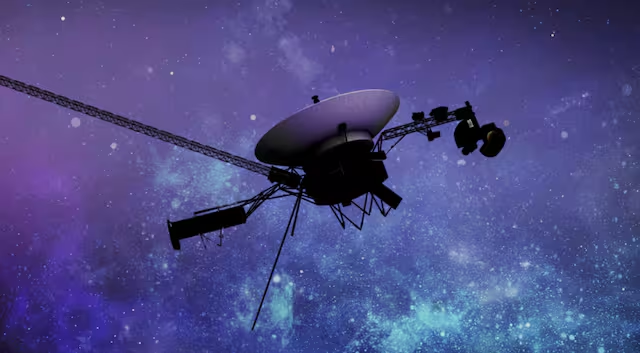
Scientists have made a breakthrough in understanding the peculiar behavior of NASA’s Voyager 1 spacecraft and the strange sounds it’s been emitting in November. Launched in 1977, Voyager 1 was sent on a mission to explore the outer reaches of our Solar System and venture into interstellar space.
Recently, Voyager 1, the furthermost spacecraft from Earth, has been sending out puzzling signals on its interplanetary “radio,” leaving scientists scratching their heads. NASA had reported earlier that engineers were troubleshooting an issue with one of Voyager 1’s onboard computers, the flight data system (FDS). This system is crucial for collecting data from scientific instruments and compiling it into a
Data package, as well as monitoring the spacecraft’s health and status.
Despite Voyager 1 receiving and executing commands from Earth, there was a communication problem between the FDS and the telecommunications unit (TMU), which transmits data back to Earth. This resulted in data reaching Earth in binary code, but it was incomprehensible gibberish to scientists.
However, progress was made when a coded message was sent to Voyager’s FDS in March, prompting the spacecraft to reveal the issue. Analysis of the data showed that three percent of Voyager’s memory was corrupted, which had previously thwarted attempts to resolve the problem by simply turning the FDS on and off.
NASA is now working on deciphering the readout and devising a potential solution, but it’s a complex process that will require time and careful analysis. The latest development marks a step forward in understanding and addressing the anomaly affecting Voyager 1’s communication system.


