
• About us
  • Privacy Policy
  • Contact us
Neo Science Hub
ADVERTISEMENT
  • Home
  • e-Mag Archives
  • e-Learning
  • Categories
    • Healthcare & Medicine
    • Pharmaceutical & Chemical
    • Automobiles
    • Blogs
      • Anil Trigunayat
      • BOOKmarked
      • Chadha’s Corner
      • Cyber Gyan
      • Raul Over
      • Taste of Tradition
        • Dr. G. V. Purnachand
      • Vantage
    • Business Hub
    • Engineering
    • Innovations
    • Life Sciences
    • Space Technology
  • PhotoSynthesis
  • Subscribe Now
  • Contact us
  • Log In
No Result
View All Result
  • Home
  • e-Mag Archives
  • e-Learning
  • Categories
    • Healthcare & Medicine
    • Pharmaceutical & Chemical
    • Automobiles
    • Blogs
      • Anil Trigunayat
      • BOOKmarked
      • Chadha’s Corner
      • Cyber Gyan
      • Raul Over
      • Taste of Tradition
        • Dr. G. V. Purnachand
      • Vantage
    • Business Hub
    • Engineering
    • Innovations
    • Life Sciences
    • Space Technology
  • PhotoSynthesis
  • Subscribe Now
  • Contact us
  • Log In
No Result
View All Result
Neo Science Hub
No Result
View All Result
  • Home
  • e-Mag Archives
  • e-Learning
  • Categories
  • PhotoSynthesis
  • Subscribe Now
  • Contact us
  • Log In

Frozen Dunes on Mars May Hold Clues About Past Climate and Potential for Life

Rashmi NSH by Rashmi NSH
2 years ago
in Science News, Space Technology
0
Mars

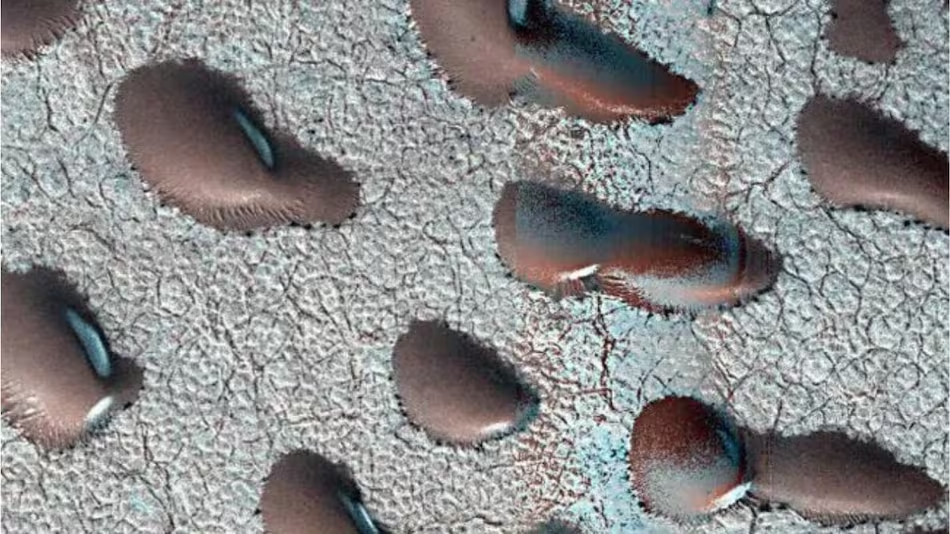
Scientists studying Mars have discovered frozen sand dunes that could reveal important details about the planet’s past climate and the possibility of life. These dunes, covered in carbon dioxide frost, stay frozen and unmoving during the winter, offering researchers a chance to study how Mars’ surface changes with the seasons.

NASA’s Mars Reconnaissance Orbiter captured an image of these frozen dunes in Mars’ northern hemisphere in 2022, according to a report by Live Science. Unlike Earth’s deserts, where wind constantly shifts sand dunes, these Martian dunes remain stationary under a layer of carbon dioxide frost during winter. The frost prevents wind from moving the sand, keeping the dunes locked in place until spring temperatures warm up and the frost sublimates (turns from solid to gas).

Studying these frozen dunes helps scientists investigate whether liquid water once existed on Mars for extended periods—long enough to potentially support life. Although the frost is made of carbon dioxide, it is closely tied to the planet’s climate history. Mars experiences more extreme shifts in its axial tilt than Earth, which can cause dramatic climate changes over millions of years.

During periods of greater axial tilt, Mars might have had a thicker atmosphere, creating conditions for liquid water to exist on the surface. These findings could provide more clues about the planet’s ability to support microbial life.

By analyzing the patterns of carbon dioxide frost and its effects on dune formations, scientists hope to uncover details about Mars’ environmental changes over time. Evidence of stable liquid water could strengthen the theory that the planet was once habitable and may even harbor life beneath its surface.

This research continues to deepen our understanding of Mars’ climate evolution and its potential role in astrobiology, bringing us closer to answering the question of whether life ever existed—or still exists—on the Red Planet.

Share this:

  • Share on X (Opens in new window) X
  • Share on LinkedIn (Opens in new window) LinkedIn
  • Share on Facebook (Opens in new window) Facebook
  • Share on WhatsApp (Opens in new window) WhatsApp
  • Share on Tumblr (Opens in new window) Tumblr
  • Share on Telegram (Opens in new window) Telegram
  • Email a link to a friend (Opens in new window) Email
Tags: featuredsciencenews
Rashmi NSH

Rashmi NSH

Other Posts

SAFETY PHARMACOLOGY STUDIES FOR HUMAN PHARMACEUTICALS S7A

SAFETY PHARMACOLOGY STUDIES FOR HUMAN PHARMACEUTICALS S7A

September 28, 2026
0
SRICO's Biggest-Ever Showing at analytica Lab India 2026

SRICO’s Biggest-Ever Showing at analytica Lab India 2026 Draws Strong Response

September 26, 2026
10

Butterflies

The Divine Grain — Sorghum

2026 Nepal floods – not a GLOF

Satish Regonda: What the River Remembers in Numbers

Anjal Prakash: The Long Walk from the Village Pump to the Planet’s Ledger

Children’s Emotional Reliance on AI Chatbots Raises Alarm

Next Post
Sunita Willams

Sunita Williams Returns to Spacewalking After 12 Years 

Subscribe to Us

Latest Articles

Mind Maze Sept 26

September 5, 2026
19

ISRO’s GSLV-F17 Injects EOS-05 into Precise Orbit in Pre-Dawn Triumph

Beyond the Booth: Smart Labtech’s Application Lab and Post-Sale Service Portfolio

Make in India at Booth C-01: Smart Labtech’s Own Engineering on Display

Rare August Snowstorms Blanketed Parts of the Bone-Dry Atacama Desert, Triggering Floods and Shutting Down Observatories

Also at Booth C-01: Spectroscopy, Sample Prep and Water Testing Solutions

  • Advertise
  • Terms and Conditions
  • Privacy Policy
  • Refund Policy
  • Contact
For Feedback : Email Us

Copyrights © 2025 Neo Science Hub

No Result
View All Result
  • Home
  • e-Mag Archives
  • e-Learning
  • Categories
    • Healthcare & Medicine
    • Pharmaceutical & Chemical
    • Automobiles
    • Blogs
      • Anil Trigunayat
      • BOOKmarked
      • Chadha’s Corner
      • Cyber Gyan
      • Raul Over
      • Taste of Tradition
      • Vantage
    • Business Hub
    • Engineering
    • Innovations
    • Life Sciences
    • Space Technology
  • PhotoSynthesis
  • Subscribe Now
  • Contact us
  • Log In

Copyrights © 2025 Neo Science Hub

Welcome Back!

Login to your account below

Forgotten Password? Sign Up

Create New Account!

Fill the forms below to register

All fields are required. Log In

Retrieve your password

Please enter your username or email address to reset your password.

Log In

Add New Playlist

Discover more from Neo Science Hub

Subscribe now to keep reading and get access to the full archive.

Continue reading