

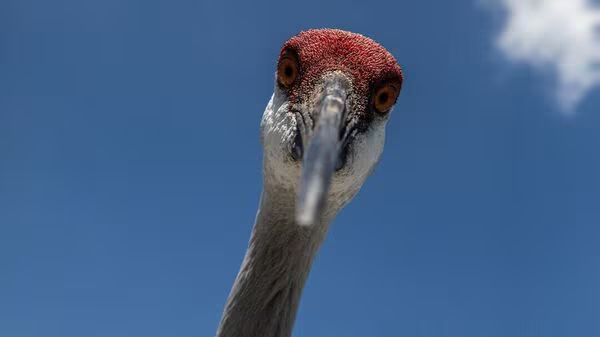
NASA, known for sharing mesmerizing images of space and nature, recently posted a striking photo on its Instagram account. This time, it wasn’t a celestial wonder but a sandhill crane that took center stage.
The space agency explained that the bird, with its large, brown eyes and graceful posture, is one of the 1,500 species of plants and animals that inhabit the Merritt Island National Wildlife Refuge, which shares space with NASA’s Kennedy Space Center. The refuge’s shallow freshwater habitats make it an ideal nesting and feeding ground for sandhill cranes, adding a unique touch of nature to the Space Coast’s technological hub.
The photograph shows a sandhill crane staring directly at the camera. Its long, slender neck and grey plumage stand out against a vibrant blue sky dotted with fluffy white clouds. In the background, the iconic Vehicle Assembly Building (VAB) is faintly visible, bearing NASA’s famous logo.
NASA described the VAB as one of the largest buildings in the world, serving as the assembly site for some of its most powerful rockets, including the Artemis I rocket that launched the Orion spacecraft around the Moon in 2022.
The image quickly gained attention, with social media users admiring the unexpected blend of nature and space exploration.
“Finally, they revealed the CEO of NASA before GTA 6,” one commenter joked.
“So beautiful, and the blue sky is perfect for a rocket launch,” another user wrote.
A playful comment read, “He’s wondering, will the rocket fly today or get delayed again?”
One user, impressed by the composition, said, “This is such a great shot of the bird. I love sandhill cranes and often photograph them when they migrate to New York. The blurred NASA logo beautifully connects space exploration with our natural world, and the clouds add a perfect touch to the sky. Fantastic work!”
This post highlights the harmony between NASA’s technological advancements and the natural beauty of its surroundings. It’s a reminder that the pursuit of space exploration goes hand-in-hand with preserving and appreciating the Earth we call home.


