

How a Couple’s Sacrifice Oxygenated Siachen
The air in the room was thick with quiet gratitude, but for Yogesh Chithade, then a serving Indian Air Force officer, the words of Honorary Captain Bana Singh, ParamVir Chakra, cut through it like the biting wind of the Himalayas. Bana Singh spoke not of enemy bullets, but of the silent killer that stalked soldiers in Siachen: the desperate, life-sapping shortage of oxygen. It was a seed that had been sown years earlier, back in 1999, when Yogesh and his wife Sumedha, a dedicated school teacher, had informally begun their journey of supporting soldiers and their families. But this conversation ignited a firestorm within them, morphing a quiet dedication into an audacious, almost improbable quest: to deliver a permanent breath of life to the world’s highest battlefield, demanding every ounce of their personal wealth and an unwavering spirit.
For most people, gold is passed down as legacy. For Sumedha and Yogesh Chithade, it became the seed of a mission. Faced with the daunting financial reality of installing a high-altitude oxygen plant in Siachen—a feat never before attempted by civilians—they didn’t wait for grants or goodwill. Instead, they turned to the sacred—their own ancestral jewellery.
Gold bangles. Earrings. Family heirlooms once meant for their daughter-in-law’s wedding trunk were quietly sold off to raise the first ₹1.25 lakh. This wasn’t symbolic; it was survival. “If I were to expect people to donate,” said Sumedha, “I would have to set an example first.” And so, with savings drained and sentiment sacrificed, they lit the torch of a citizen-led campaign to combat the deadliest enemy at 13,000 feet: thin air.
This act of personal renunciation wasn’t born out of privilege or publicity. It was born from duty, the kind that whispers louder than slogans: a duty to soldiers whose names they may never know, but whose pain they intimately understood.
What followed was not a fairy tale—it was an 18-month test of character. Beginning April 24, 2018, the couple embarked on a relentless public campaign across Maharashtra. More than 100 PowerPoint presentations—some estimates say as many as 140—were delivered to school halls, corporate boardrooms, local clubs, and religious gatherings.
Each slide carried the story of Siachen’s soldiers gasping for breath. Each talk pleaded not for charity, but for solidarity. Sometimes they were welcomed with open arms. Often, they were turned away with polite applause and no donation. Yet, they pressed on.
Their message was clear: If the government couldn’t reach every crevasse, maybe citizens could. And they didn’t just ask for money. They offered understanding. Awareness. A connection to the men stationed at altitudes where even birds don’t fly.
Emotionally, it took its toll. Rejections stung. Logistics overwhelmed. At times, the fundraising teetered on collapse. But they had a deadline—October 15, 2019—after which winter would make Siachen’s terrain inaccessible. If they failed, the plant couldn’t be installed for another year. And soldiers would keep gasping.
They considered mortgaging their home. They calculated loans. And each time they thought of stopping, they remembered Bana Singh’s words, the trembling voice behind the ParamVir Chakra, speaking not of war—but of breath.
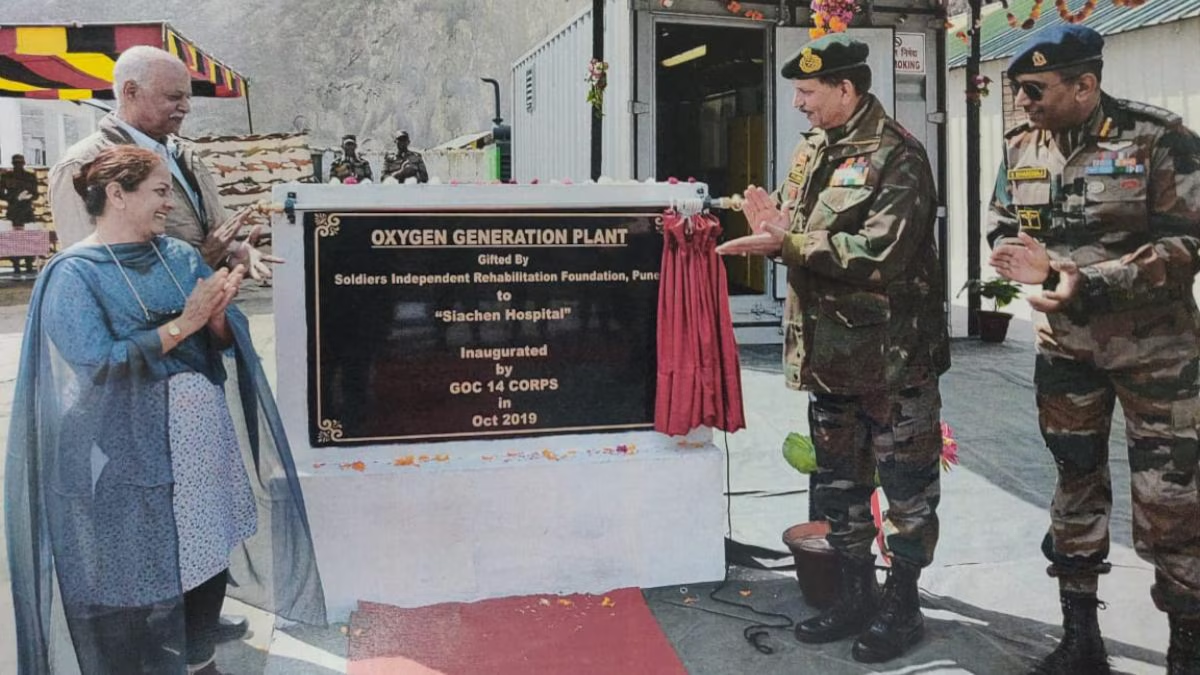
October 4, 2019. Siachen Base Camp. At 13,000 feet, the air is thin and biting, but that day it carried something miraculous: oxygen, generated not from transported cylinders but from a newly-installed plant built through tears, tenacity, and trust.
Lt Gen Y.K. Joshi inaugurated the German-imported machine, a marvel of engineering customized for the harsh terrain. Soldiers lined up, not to salute, but to say thank you—with mist in their eyes. Some walked up to Yogesh, broke down, and whispered, “Aapne Bhagwan ka kaam kiya hai.”
The numbers were staggering—over 20,000 lives touched, including 8,000 soldiers and thousands of locals and tourists in the Nubra Valley. But beyond numbers, this was a moral victory. It was a moment where science served humanity, where altruism overpowered altitude.
And the plant did more than pump oxygen. It pumped morale. In a place where frostbite is common and loneliness even more so, the soldiers now knew—they were not forgotten. They were seen. They were loved.
While the world often celebrates loud achievements, the Chithades chose silence as their signature. No press conferences. No media blitz. No attempt to turn goodwill into gain. Their mission was never about attention—it was about breath. Quietly, consistently, and with unfaltering purpose, they focused only on one thing: the soldier’s life.
There were no corporate logos on the oxygen plant, no banners screaming their names. Even when the Prime Minister personally invited them to his residence—a rare and humbling recognition—they accepted with grace but returned to their quiet life in Pune soon after. “We just did what needed to be done,” Sumedha would say, brushing off questions about sacrifice with the same simplicity that marked their entire journey.
They are not just donors; they are doers. And in a time when philanthropy often masquerades as branding, the Chithades remind us what true altruism looks like. It is persistent. It is practical. And above all, it is profoundly personal.
Engineering a Solution, Not Just Sympathy
It would have been easier to write a cheque. Or donate a few oxygen cylinders. But Yogesh and SumedhaChithade weren’t interested in temporary relief. They were fixated on permanence.
This was not charity—it was civilian innovation, rooted in empathy-driven engineering. Yogesh undertook exhaustive research to select a single-manufacturer German oxygen plant that could be maintained with minimal intervention in the harsh Siachen environment. He foresaw what few might: that modular systems might fail due to lack of technician access at high altitudes. This wasn’t just benevolence—it was a systems-level intervention.
Their model is not replicable because it’s grand; it is replicable because it is grounded. Identify the problem. Engage the community. Sacrifice if you must. Solve with foresight. And never demand applause.
In an era of viral posts and televised gestures, the Chithades’ journey whispers a different kind of courage—the kind that doesn’t need to be seen to be believed. Their names weren’t trending on social media. Their speeches didn’t echo in headlines. But their actions now echo in the breath of every soldier at 13,000 feet.
As Yogesh once said to a fellow volunteer, “While many talk about problems, some solve them. Fewer still do so silently.”
That silenceis where real heroism lives.
The Challenge
Siachen is more than a glacier; it is an altitude-induced crucible where nature tests endurance, and even oxygen becomes a luxury. At heights ranging from 11,000 to 21,000 feet, the air holds barely half the oxygen available at sea level. Temperatures plunge to -60°C. Winds pierce through bone. And soldiers, despite the best of training, are not immune to the biology of deprivation.
Here, altitude sickness is not a maybe—it’s a constant threat. Hypoxia, High-Altitude Pulmonary Edema (HAPO), and High-Altitude Cerebral Edema (HACO) are frequent visitors. These conditions, if untreated, can rapidly escalate into fatal strokes, organ failure, and death. The standard response—oxygen cylinders flown in from the plains—was always a logistical nightmare. The IL-76 aircraft that delivered them often braved unpredictable weather and treacherous landing conditions, while soldiers remained vulnerable in between shipments.
Oxygen, in Siachen, is not just medicine—it’s the margin between survival and silence.
The Solution
Enter the Chithades—not with cargo planes or political clout, but with scientific clarity and compassionate precision. YogeshChithade, drawing from his Air Force discipline, refused to settle for a stopgap measure. He researched, vetted, and finally selected a state-of-the-art oxygen generation unit—imported from Germany—from a single manufacturer, to ensure streamlined maintenance in a zone where waiting for spare parts could cost lives.
The plant operates on advanced principles akin to Pressure Swing Adsorption (PSA)—a method that extracts oxygen directly from ambient air by separating it from other gases using molecular sieves. While we simplify the science for readers, the outcome is nothing short of transformative: the plant draws oxygen from the thin Siachen atmosphere itself, generating life-sustaining purity right where it’s needed.
This wasn’t just innovation—it was logistical liberation. By eliminating the need for bulky, risk-laden oxygen cylinder transport, the plant reshaped the Army’s operational efficiency. The supply became stable, immediate, and indigenous to the glacier—a miracle made mundane through engineering.
The Impact
The numbers themselves are arresting. Depending on deployment, altitude, and local needs, the plant serves anywhere between 8,000 to 40,000 people—including soldiers, civilians in Nubra Valley, and even tourists. Its cost ranged between ₹1.1 crore to ₹2.5 crore, depending on estimates, but the value it generated is incalculable.
And it didn’t stop at war zones.
When the COVID-19 pandemic spread panic and gasping lungs across the nation, the same oxygen plant that was meant to serve soldiers proved to be a vital medical asset for the region. Hospitals in remote Ladakh were able to stabilize patients thanks to the oxygen originally intended for the battlefield—an unexpected extension of its utility.
But beyond physiology, the impact was profoundly psychological. For soldiers stationed at the edge of the world, the very knowledge that citizens—ordinary, unarmed, uninvited—had built this lifeline, was a morale boost more potent than any medal. It told them: You are not alone. The nation breathes with you.
– Sivarama Murthy Yellamraju
Legacy in Motion
What the Chithades Continue to Teach a Nation
In a world dazzled by declarations and decorated speeches, Yogesh and SumedhaChithade quietly rewrote what it means to serve. They didn’t wait for permission or policy. They saw a life-threatening problem—oxygen scarcity in Siachen—and chose to solve it. Not through protest or power, but with quiet resolve, engineering insight, and the profound sacrifice of personal wealth.
What they achieved wasn’t just a donation. It was a blueprint for responsible citizenship, blending compassion with innovation, service with science.
And their mission didn’t end at the Siachen base camp.
Their foundation—Soldiers Independent Rehabilitation Foundation (SIRF)—helped modernize the Spinal Cord Injury Centre at Military Hospital, Khadki. They donated a solar water heating system and a computerized stair trainer, offering comfort and mobility to paraplegic soldiers. The tools changed lives. The spirit behind them moved mountains.
Today, SIRF’s evolving work reminds us that true legacy is not etched in stone—it breathes, adapts, and continues. It calls on each of us to reflect: Where can we roll up our sleeves? How can we serve?
Because sometimes, the most powerful gesture is ensuring that someone, somewhere, far from home… can take their next breath.


