

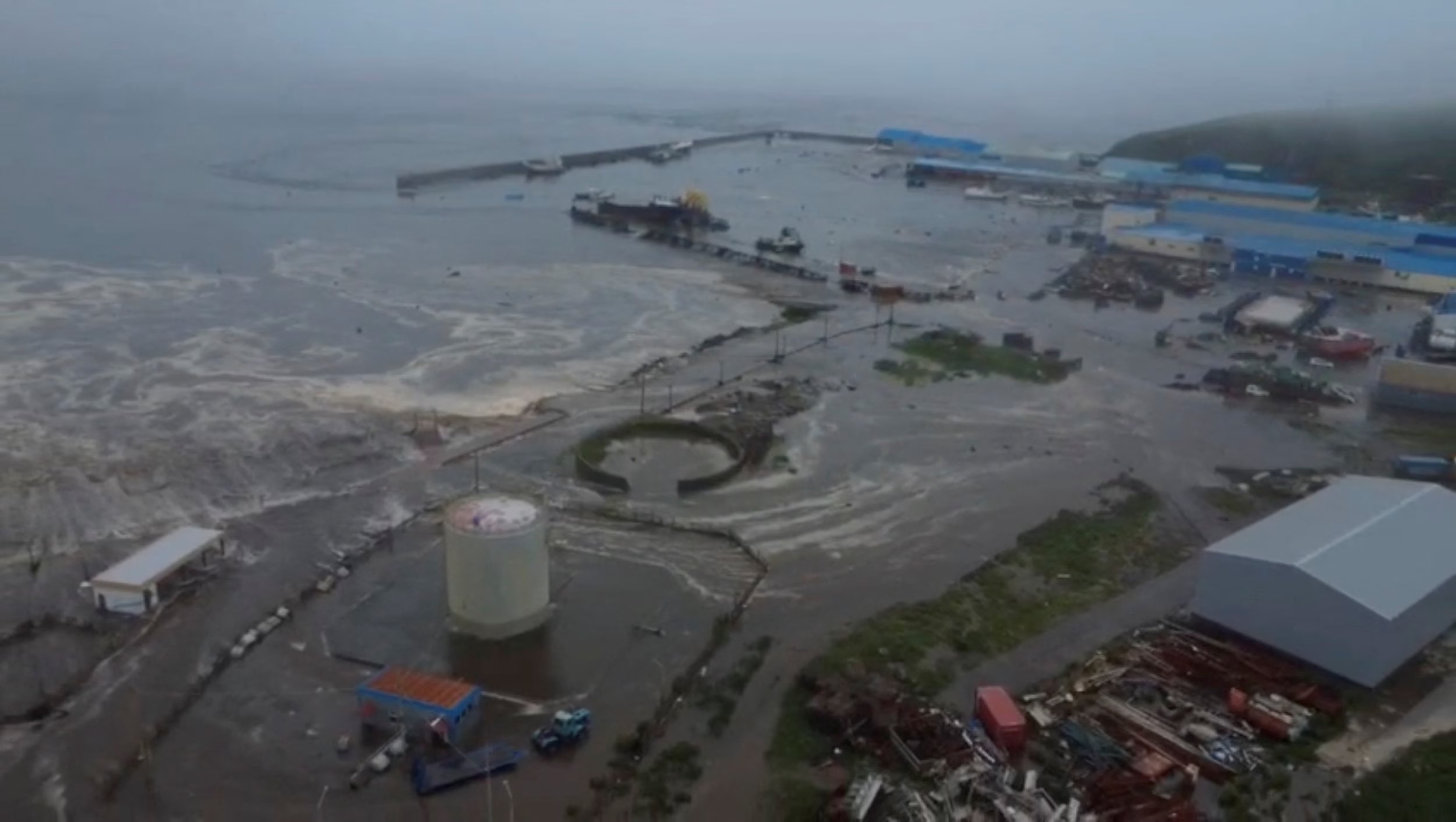
Roaring waves swallowed port towns, fishing boats hurled inland like toys, and sirens echoed across the Pacific Rim as a colossal undersea quake struck off Russia’s Kamchatka coast. From Japan to Hawaii, millions braced for the worst—reminding the world, and India, that the sea’s fury can awaken without warning.
Yesterday’s massive 8.8 magnitude earthquake off Russia’s Far Eastern Kamchatka Peninsula jolted the Pacific Rim into high alert. Coastal areas from Russia and Japan to Hawaii and even Latin America braced for tsunamis, invoking emergency plans. In Russia’s Kamchatka and Kuril Islands near the epicenter, waves 3–5 meters high crashed ashore, flooding a port town and sweeping boats from their moorings. Verified footage showed the shoreline of Severo-Kurilsk completely submerged. Hawaii and Japan, both with painful history of tsunamis, recorded more moderate surges – up to 1.7 m in Hawaii and 1.3 m in Japan – prompting authorities to downgrade warnings by evening as the threat waned. Still, millions were evacuated in coastal Japan and thousands in Hawaii were sent to higher ground as a precaution. Even parts of California and South America were under tsunami advisories, a testament to how far seismic waves can travel. Thankfully, the worst fears did not materialize; by nightfall, the Pacific-wide alerts were largely lifted as actual wave heights proved lower than initial forecasts.
Crucially, science and preparedness helped avert tragedy. Kremlin officials reported no casualties in Russia, crediting solid building construction and the smooth operation of alert systems for protecting lives. In Japan and Hawaii, swift public warnings and orderly evacuations ensured people were out of harm’s way in time. This event showcased how much early warning technology has advanced: within minutes of the quake, tsunami centers across the world had modeled its impact and sounded alarms. Deep-ocean pressure sensors (tsunami buoys) detected the moving wave energy and fed data to update forecasts in real time. Scientists note that while initial warnings rely on estimated quake size and location, these sensor networks allow continual refinement of tsunami height and arrival predictions. In this case, as more data came in, many alerts were scaled back when it became clear the waves would be moderate, not massive. The Pacific Tsunami Warning System’s effectiveness – and even an evacuation at Fukushima’s nuclear site as a safeguard – underscore a culture of “better safe than sorry” ingrained around the Ring of Fire.
Indian Memories and Preparedness Post-2004
From an Indian vantage point, any tsunami scare revives memories of the 2004 Indian Ocean tsunami – a catastrophe that devastated India’s coasts without warning. That magnitude 9.1 earthquake near Sumatra unleashed waves up to 30 meters, killing over 280,000 people across 14 countries, including more than 10,000 in India. The stark difference between 2004 and 2025 is preparedness. Two decades ago, the Indian Ocean had no tsunami warning system; coastal communities were caught completely off-guard. Today, India stands far better equipped. The tragedy spurred the establishment of the Indian Ocean Tsunami Warning System by 2006. India in particular set up its own advanced Tsunami Early Warning Centre in Hyderabad, operational since 2007. This 24×7 center at INCOIS (Indian National Centre for Ocean Information Services) is the pride of India’s science-driven disaster management. It comprises a real-time network of seismic stations, bottom pressure recorders on the seafloor, and coastal tide gauges – all linked by satellite to monitor the seas. Thanks to this, any undersea quake in the Indian Ocean exceeding a certain magnitude triggers instant computerized modeling of potential tsunami waves. Alerts can be issued within 10 minutes of a major tremor, buying precious time for at-risk populations to evacuate. India’s center not only guards its own coastline but also serves as a Regional Service Provider, sharing tsunami advisories with other Indian Ocean nations.
Lessons learned from 2004 have translated into concrete action in India:
- State-of-the-art detection: Dozens of seismic sensors and deep-sea tsunami buoys now ring the Indian Ocean, enabling rapid detection of tsunamigenic earthquakes and accurate wave forecasts.
- Fast communication: Alerts are disseminated via multiple channels (SMS, email, sirens, media) to ensure coastal communities get timely warnings.
- Community drills and awareness: Regular evacuation drills and public education campaigns have been implemented in coastal districts, so that people recognize natural tsunami signs (like sudden sea retreat) and know how to respond. International initiatives like UNESCO’s Tsunami Ready program have further bolstered local preparedness, fostering a culture of readiness and resilience in India’s coastal populace.
Science, Vigilance and the Road Ahead
The Kamchatka quake’s aftermath — minimal damage despite its power — highlights how far science and vigilance have come. Early warning systems and resilient infrastructure saved countless lives this week, in stark contrast to past disasters. For India, watching the Pacific alerts from afar was a reminder that nature’s fury knows no borders, and preparedness is paramount even when a specific threat doesn’t reach our shores. After all, the tectonic forces that shook Kamchatka are the very same that lurk along the Indo-Andaman plate boundary near us. As an emerging science and tech leader, India must continue to invest in research, technology, and international cooperation to improve hazard models and warning networks. The goal is not just to match the world’s best practices, but to lead – ensuring that the tragedy of 2004 is never repeated anywhere. Our ability to predict and withstand tsunamis is a triumph of science, but it’s an unfinished journey. Each quake and tsunami, whether in the Pacific or Indian Ocean, teaches us to refine our systems. Eternal vigilance, bolstered by cutting-edge technology and community preparedness, is the price of safety along Earth’s volatile coastlines. In the face of unpredictable oceans, India stands resolute – turning hard-won lessons into life-saving action, and using science to stay one step ahead of the next tsunami.
– Rama Koundinya Potharaju


