
• About us
  • Privacy Policy
  • Contact us
Neo Science Hub
ADVERTISEMENT
  • Home
  • e-Mag Archives
  • e-Learning
  • Categories
    • Healthcare & Medicine
    • Pharmaceutical & Chemical
    • Automobiles
    • Blogs
      • Anil Trigunayat
      • BOOKmarked
      • Chadha’s Corner
      • Cyber Gyan
      • Raul Over
      • Taste of Tradition
        • Dr. G. V. Purnachand
      • Vantage
    • Business Hub
    • Engineering
    • Innovations
    • Life Sciences
    • Space Technology
  • PhotoSynthesis
  • Subscribe Now
  • Contact us
  • Log In
No Result
View All Result
  • Home
  • e-Mag Archives
  • e-Learning
  • Categories
    • Healthcare & Medicine
    • Pharmaceutical & Chemical
    • Automobiles
    • Blogs
      • Anil Trigunayat
      • BOOKmarked
      • Chadha’s Corner
      • Cyber Gyan
      • Raul Over
      • Taste of Tradition
        • Dr. G. V. Purnachand
      • Vantage
    • Business Hub
    • Engineering
    • Innovations
    • Life Sciences
    • Space Technology
  • PhotoSynthesis
  • Subscribe Now
  • Contact us
  • Log In
No Result
View All Result
Neo Science Hub
No Result
View All Result
  • Home
  • e-Mag Archives
  • e-Learning
  • Categories
  • PhotoSynthesis
  • Subscribe Now
  • Contact us
  • Log In

Guardian of the Skies: Chandramouli Gaddamanugu’s Three-Decade Mission to Secure India’s Airspace

Rashmi NSH by Rashmi NSH
7 months ago
in Science News
0
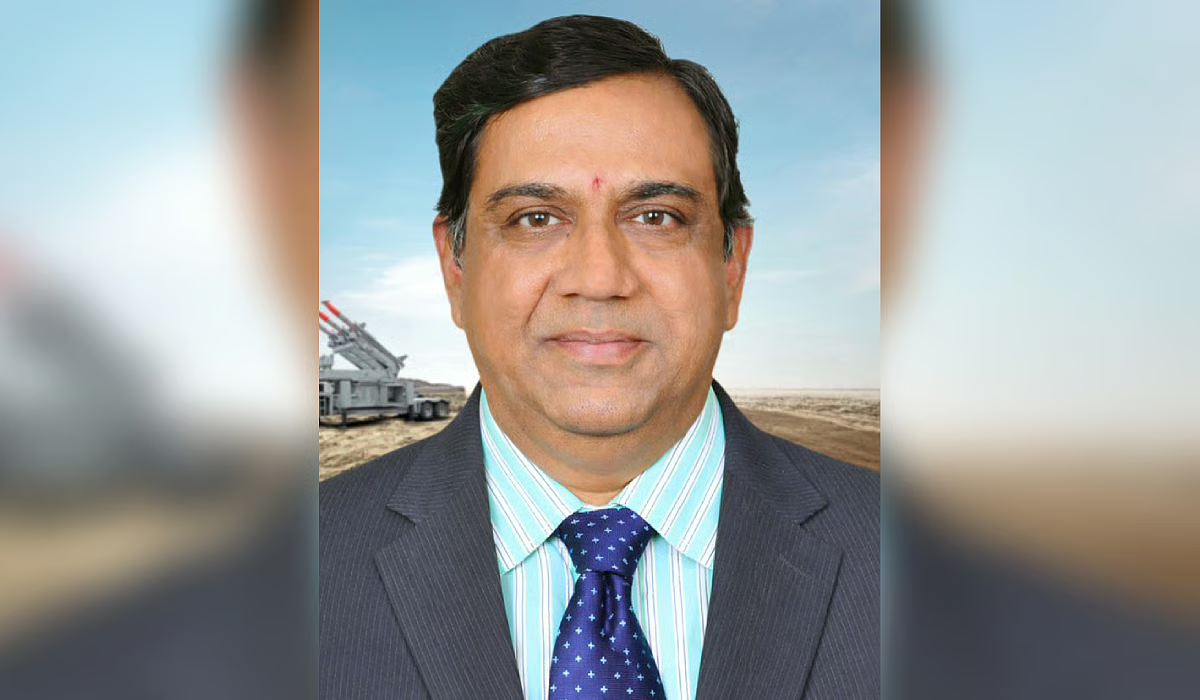
Chandramouli Gaddamanugu | Neo Science Hub

Padma Shri | Science & Engineering (Aerospace Defence) | Telangana

When the Akash missile system demonstrated its stellar performance during Operation Sindoor, neutralizing aerial threats with precision that surprised international observers, it represented the culmination of a 34-year journey. At the heart of this achievement stood Chandramouli Gaddamanugu, the aerospace engineer from Madhira, Khammam district, who dedicated his entire DRDO career to transforming India’s air defense capabilities from vulnerable to formidable.

The significance of Gaddamanugu’s Padma Shri extends beyond individual recognition—it honors the patient, persistent work of building indigenous defense capabilities. When he joined the Akash project in 1983 as one of three founding members under Dr. A.P.J. Abdul Kalam’s Integrated Guided Missile Development Programme, skepticism pervaded. Few believed India could develop a sophisticated surface-to-air missile system capable of tracking 64 targets simultaneously and engaging 12 of them. The technical challenges were immense: creating a supersonic multi-target system with automated air defense functions that could neutralize threats ranging from fighter jets to cruise missiles, regardless of altitude or size.

What distinguishes Gaddamanugu’s contribution is his understanding that technological breakthroughs require more than brilliant individuals—they demand sustained institutional collaboration. As Project Director, he orchestrated cooperation across research institutes, defense industries, and military personnel, navigating bureaucratic complexities while maintaining technical excellence. The first successful flight in 1994, followed by evaluation trials in 2006-07 and formal induction into both the Army and Air Force in 2015, represents a masterclass in translating fundamental research into operational systems.

The vindication came during Operation Sindoor, when Akash performed beyond expectations. According to the Indian Army’s Director General of Military Operations, the system played a pivotal role in neutralizing drones and missiles during the India-Pakistan conflict. Dr. B.K. Das, DRDO’s Director General for Electronics & Communication Systems, confirmed Akash’s stellar performance. For Gaddamanugu, this operational success validated decades of persistence through failures, scrutiny, and doubt. As he recalls, Kalam’s guidance—”first develop technology, the rest will follow”—sustained the team through challenging moments.

Gaddamanugu’s insistence on dedicating his Padma Shri to Akash teams across India reflects profound leadership wisdom. He recognizes that indigenous defense capabilities emerge from collective effort, not individual genius. His mechanical engineering degree from NIT Warangal and M.Tech from IIT Delhi provided technical foundation, but his real education came from coordinating diverse stakeholders toward a shared mission of national security.

The broader implications of this recognition resonate deeply. As India pursues strategic autonomy and self-reliance in defense, the Akash story offers a blueprint. It demonstrates that with sustained commitment, institutional support, and collaborative spirit, India can develop world-class defense systems. The system’s reported export potential and its performance at high altitudes during recent trials further validate the original vision. Gaddamanugu’s Padma Shri celebrates not just technological achievement but the patient, persistent work of building national capability—a legacy that will protect Indian skies for generations to come.

–Rashmi Kumari

Share this:

  • Share on X (Opens in new window) X
  • Share on LinkedIn (Opens in new window) LinkedIn
  • Share on Facebook (Opens in new window) Facebook
  • Share on WhatsApp (Opens in new window) WhatsApp
  • Share on Tumblr (Opens in new window) Tumblr
  • Share on Telegram (Opens in new window) Telegram
  • Email a link to a friend (Opens in new window) Email
Tags: Padma Shri Awards 2026
Rashmi NSH

Rashmi NSH

Other Posts

Mind Maze Sept 26

September 5, 2026
1
ISRO's GSLV-F17 Injects EOS-05 into Precise Orbit in Pre-Dawn Triumph

ISRO’s GSLV-F17 Injects EOS-05 into Precise Orbit in Pre-Dawn Triumph

September 4, 2026
4

Beyond the Booth: Smart Labtech’s Application Lab and Post-Sale Service Portfolio

Make in India at Booth C-01: Smart Labtech’s Own Engineering on Display

Rare August Snowstorms Blanketed Parts of the Bone-Dry Atacama Desert, Triggering Floods and Shutting Down Observatories

Also at Booth C-01: Spectroscopy, Sample Prep and Water Testing Solutions

Analytik Jena: One Bench, Three Measurement Problems Solved

Why Snake Embryos Always Coil the Same Way: A Detached, Slow-Growing Gut Is the Culprit, Study Finds

Next Post
The Metallurgical Architect: Krishnamurty Balasubramanian’s Quest for Materials Independence

The Metallurgical Architect: Krishnamurty Balasubramanian's Quest for Materials Independence

Please login to join discussion

Subscribe to Us

Latest Articles

Mind Maze Sept 26

September 5, 2026
1

ISRO’s GSLV-F17 Injects EOS-05 into Precise Orbit in Pre-Dawn Triumph

Beyond the Booth: Smart Labtech’s Application Lab and Post-Sale Service Portfolio

Make in India at Booth C-01: Smart Labtech’s Own Engineering on Display

Rare August Snowstorms Blanketed Parts of the Bone-Dry Atacama Desert, Triggering Floods and Shutting Down Observatories

Also at Booth C-01: Spectroscopy, Sample Prep and Water Testing Solutions

  • Advertise
  • Terms and Conditions
  • Privacy Policy
  • Refund Policy
  • Contact
For Feedback : Email Us

Copyrights © 2025 Neo Science Hub

No Result
View All Result
  • Home
  • e-Mag Archives
  • e-Learning
  • Categories
    • Healthcare & Medicine
    • Pharmaceutical & Chemical
    • Automobiles
    • Blogs
      • Anil Trigunayat
      • BOOKmarked
      • Chadha’s Corner
      • Cyber Gyan
      • Raul Over
      • Taste of Tradition
      • Vantage
    • Business Hub
    • Engineering
    • Innovations
    • Life Sciences
    • Space Technology
  • PhotoSynthesis
  • Subscribe Now
  • Contact us
  • Log In

Copyrights © 2025 Neo Science Hub

Welcome Back!

Login to your account below

Forgotten Password? Sign Up

Create New Account!

Fill the forms below to register

All fields are required. Log In

Retrieve your password

Please enter your username or email address to reset your password.

Log In

Add New Playlist

Discover more from Neo Science Hub

Subscribe now to keep reading and get access to the full archive.

Continue reading